Pitch deck structure: the 9 blocks investors look for
Investors don’t read your deck. They scan it for answers. Here are the 9 blocks they expect to find, in order, and what each one has to tell them.
In this article
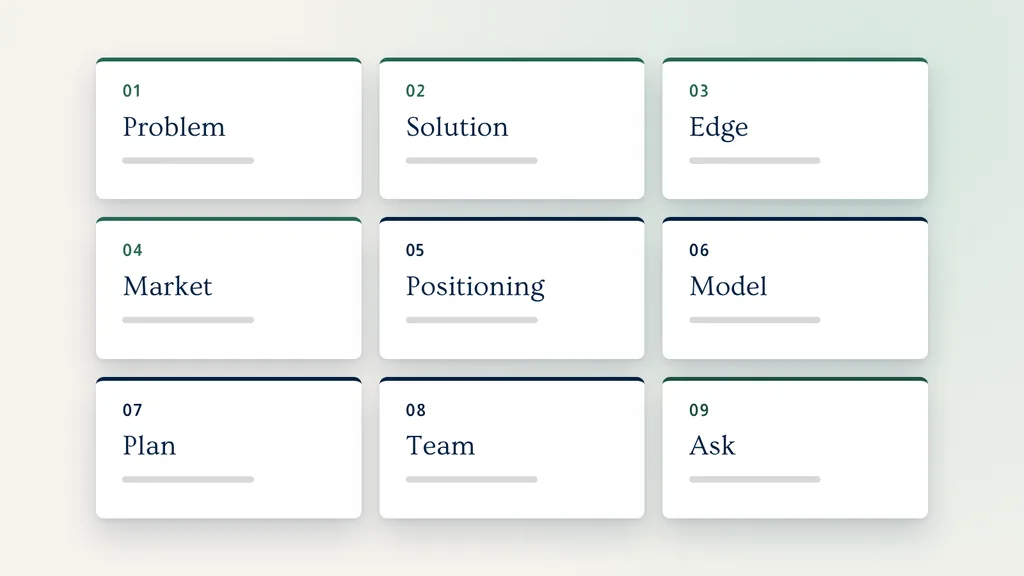
A strong pitch deck answers nine questions in 10 to 15 slides: what problem, what solution, why you, how big the market is, who else is out there, how you make money, what the plan is, who the team is, and how much you are asking for. Miss one, or put it too late, and you lose the reader. Order matters almost as much as content.
None of this is secret. It is the structure incubators recommend to their startups, and the one we use for every deck we build. Here are the 9 blocks, one at a time.
01Problem
Start with the pain, not the product. Who is struggling, with what, and what it costs them today in time, money or risk. A good problem slide fits in one sentence the investor could repeat to a partner that evening.
02Solution
Show what you do, plainly, and tie it directly to the problem you just set up. A product screenshot or a simple diagram beats a paragraph. The investor should understand within seconds what the customer actually gets.
03Your edge
This is the block many decks skip: why you, and why now. Proprietary technology, privileged access to a market, rare expertise, a regulatory change that opens a window. It is what makes your solution hard to copy.
04Market
The investor wants to know whether the opportunity is big enough to justify the cheque. Size your market with a method they can check: who your customers are, how many there are, what they pay. TAM, SAM and SOM only help if the maths behind them is clear.
A small, well-built number earns more trust than a big, borrowed one.
05Competitive positioning
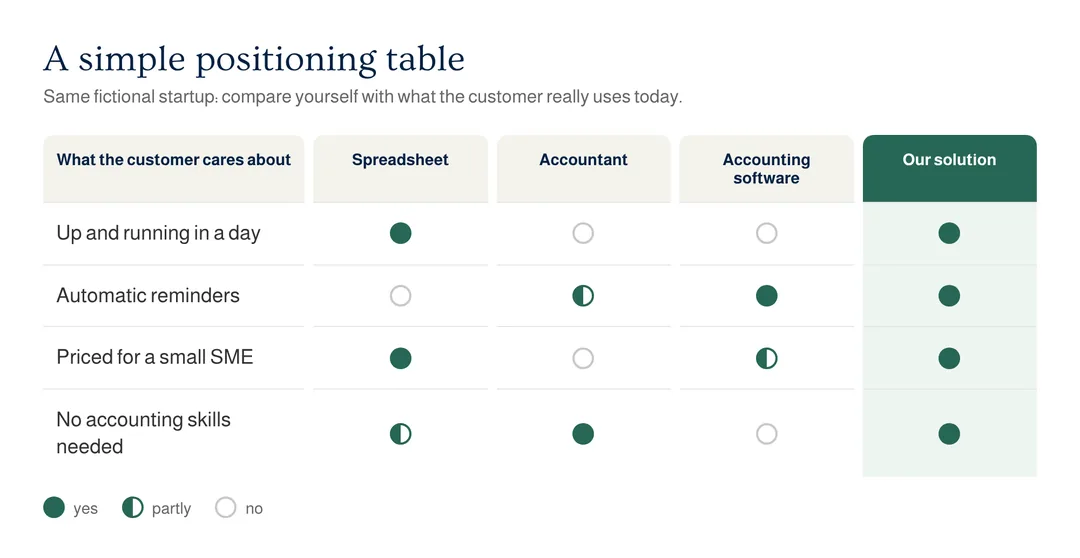
"We have no competitors" is the sentence that worries investors most. There is always an alternative, even if it is a spreadsheet or doing nothing at all. A simple table comparing your solution with the two or three options your customer really has is usually enough.
06Business model
How you make money, who pays, how much and how often. Subscription, commission, one-off sale, licence: the investor should be able to do the maths in their head. If you already have revenue, this is where it goes.
07Plan
What you will do over the next 12 to 24 months, and how you will win customers. Concrete steps, with dates and numbers. This is also where you show what you have already achieved: first customers, a pilot, an award, a place in an incubator.
08Team
Why you are the right people to build this. Not a full CV: for each person, the experience that matters for this specific project. If a key skill is missing, say so and explain how you plan to fill the gap. Honesty reassures more than a team that looks too perfect.
09The ask
How much you are raising, what it is for, and which milestone it gets you to. "We are raising CHF 500k to reach 50 paying customers and break even within 18 months" tells an investor everything they need. Too many decks end without saying clearly what they want: a wasted opportunity.
In what order?
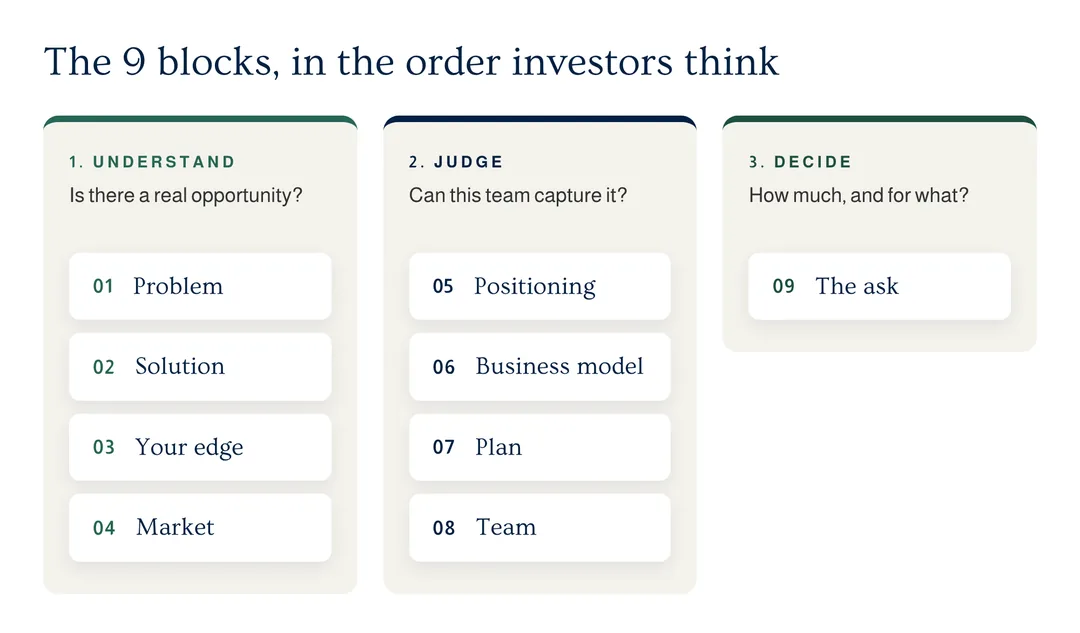
The order above is the most common, and it works because it follows the investor’s own reasoning: first understand the opportunity (blocks 1 to 4), then judge whether you can capture it (blocks 5 to 8), then decide (block 9).
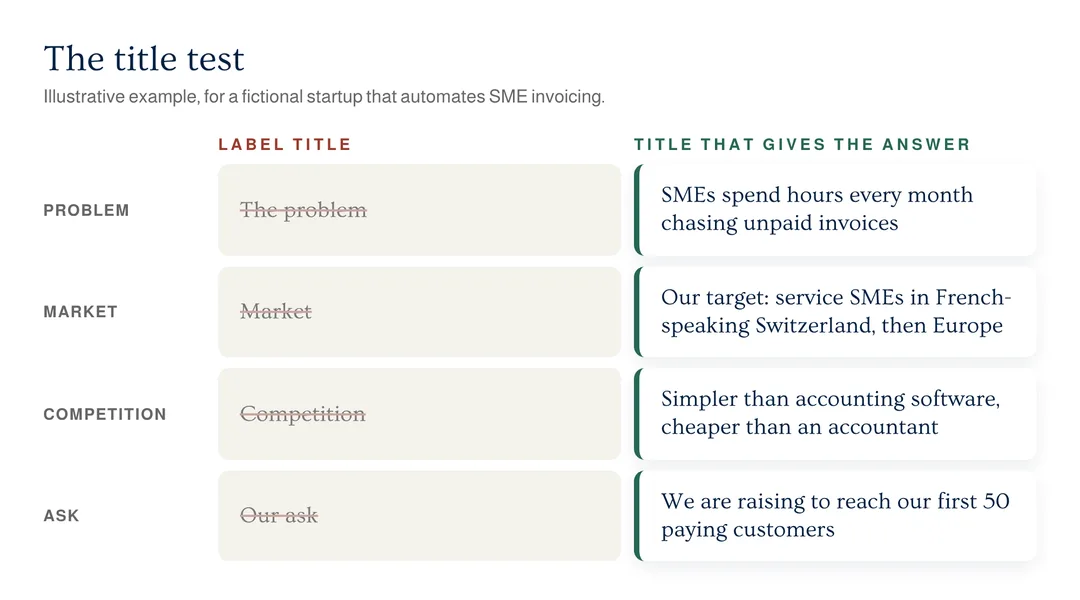
You can adapt it. If your team is your strongest asset, say founders who have already sold a company, the team can move up. If you already have strong traction, show it on the second or third slide. What does not change: each slide answers one question, and its title gives the answer.
Three checks before you send your deck
- The title test: read only your slide titles, one after the other. They should tell your story on their own.
- One idea per slide: if a slide needs more than 30 seconds of explanation, it probably holds two ideas.
- Numbers you can back up: every market or growth figure should hold up if the investor asks where it comes from.
Knowing the 9 blocks is the easy part
Many founders already know these 9 blocks. The real work starts when you have to fill them with your own project.
- Choosing. There is usually too much material: existing slides, the accounts, projections, notes, sometimes a video. The deck keeps only a small part of it, and that selection is what makes the difference.
- Finding each slide’s sentence. A title that gives the answer means knowing exactly what you want to say. It is rarely the first draft.
- Making the story and the numbers agree. Market, business model, plan and ask have to tell the same story. Investors quickly spot a figure that does not fit.
- Stepping back. After months on a project, it is hard to see what is clear to you but not to someone discovering it in three minutes.
That is the work we do with founders, starting from what they already have. If you are preparing an investor meeting or an incubator application, book a 20-minute call: we look at your project together, with no commitment.
Frequently asked questions
How many slides should a pitch deck have?
Between 10 and 15 slides for the version you present. That is enough to cover the 9 blocks without overloading anyone. Details such as the full financial model or market studies belong in an appendix or in the business plan.
Do I need a business plan before making a pitch deck?
No. A pitch deck can be built from a structured discussion about your project. The numbers in the deck do need to be consistent, though, and an interested investor will sooner or later ask for a more detailed financial model.
Can I send the same deck by email and present it in a meeting?
You can, but two versions work better. The email deck has to make sense on its own, so it carries a little more text. The presentation deck can be more visual, because you are there to explain it.